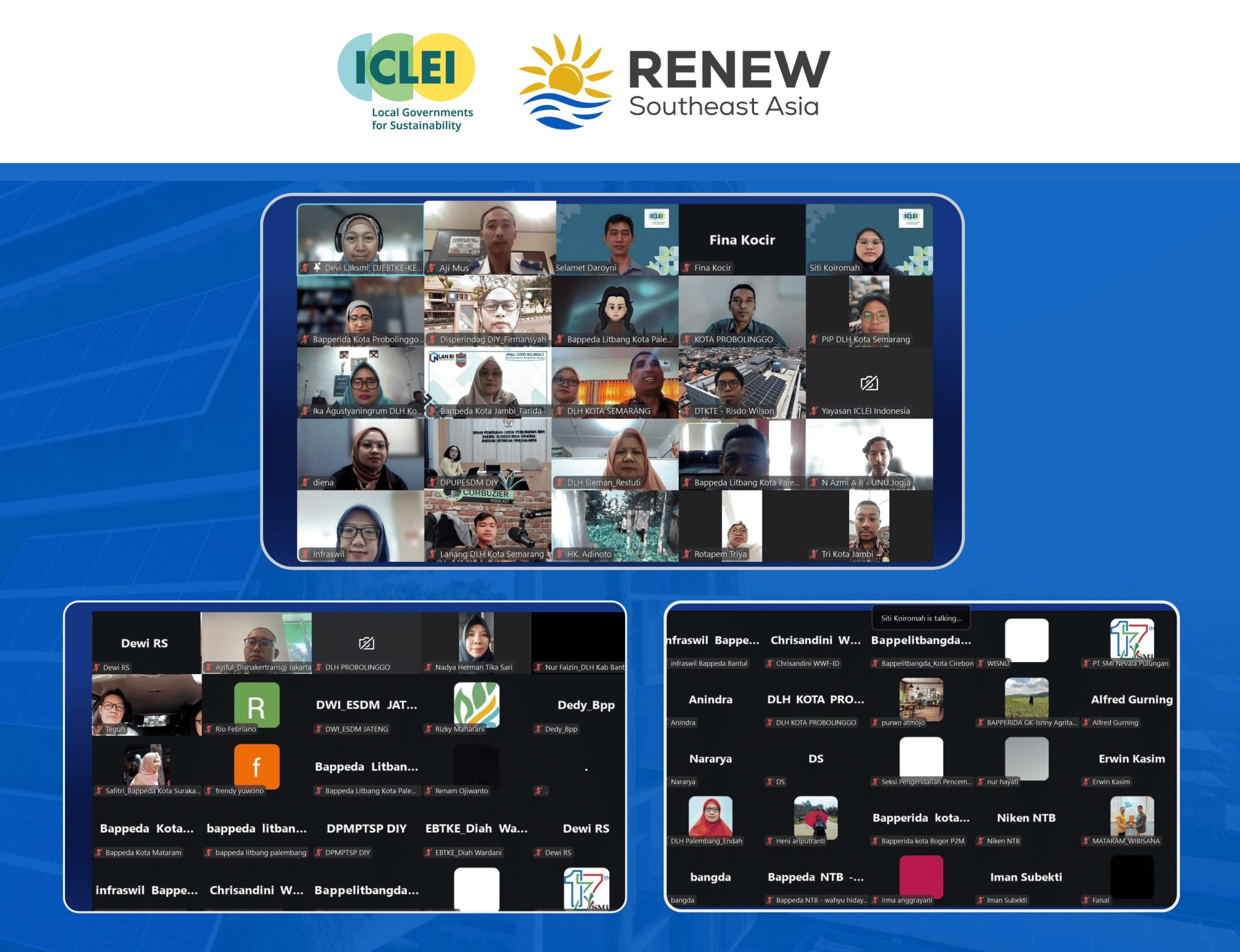
More than 80 local governments across Indonesia participated in exchange discussions during a renewable energy-focused peer learning session on 12 March 2026.
More than 80 Indonesian local governments gathered online to exchange practical experiences on improving energy sustainability in public buildings during a RENEW-SEA peer learning activity on 12 March 2026.
Themed “Promoting Energy Efficiency and Clean Energy in Public Buildings,” the exchange explored how local governments can strengthen capacity to align with national energy conservation policies, expand renewable energy (RE) use, and implement energy audits and efficiency improvements in public buildings.
Major cities and regions such as Jakarta, Central Java, and Yogyakarta Special Region shared how they are mobilizing investment, strengthening regulatory frameworks, and operationalizing energy efficiency and renewable energy initiatives in public buildings.
Speaking at the event, Devi Laksmi, Coordinator for Energy Conservation Development, Directorate of Energy Conservation, Indonesian Ministry of Energy and Mineral Resources (MEMR), outlined national policy directions on energy efficiency (EE) in the government building sector, focusing on energy management, minimum energy performance standards (SKEM), energy efficiency labelling, and increased use of RE and electrification.
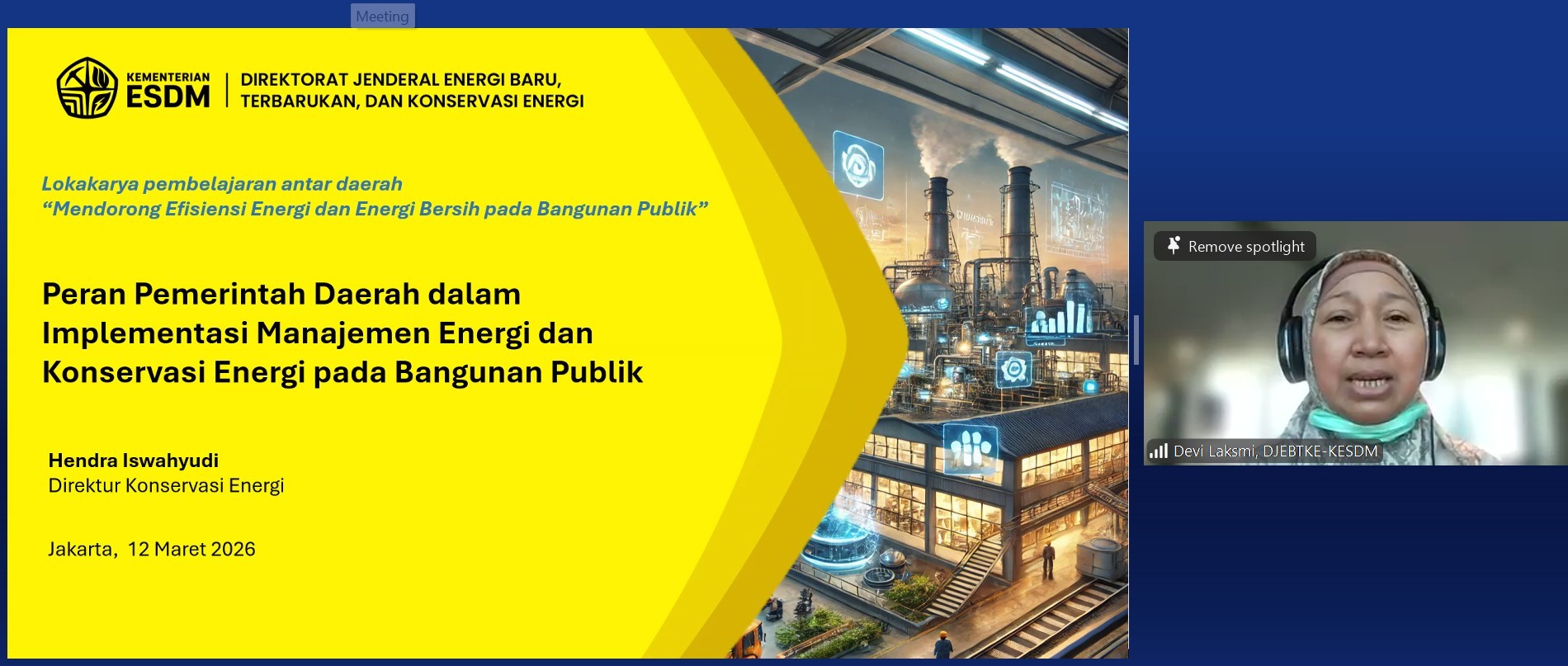
Devi Laksmi, Coordinator for Energy Conservation Development at the Directorate of Energy Conservation, Indonesian Ministry of Energy and Mineral Resources (MEMR), is seen presenting on the national policy direction for energy efficiency on 12 March 2026.
With stronger policies now in place, she emphasized that “local governments need to develop energy efficiency programs, conduct regular energy audits, and implement the recommendations from those audits.”
This momentum is also reflected in emerging local initiatives. Riau Province is using a digital platform to monitor energy consumption, Central Java Province is encouraging innovation through efficiency competitions, and Sukoharjo Regency has been nationally recognized for programs that cut energy use while also creating skilled jobs. Together, these efforts show a clear shift toward stronger local leadership in sustainable energy.
As funding continues to pose a challenge, a financing mechanism through Energy Service Companies (ESCOs) offers an alternative funding option to supporting energy efficiency projects. Through this model, ESCOs can assist local governments in conducting energy audits, installing energy-efficient technologies, and verifying the implementation and performance of energy efficiency measures.
Laksmi further elaborated on key insights, noting that there are an estimated more than 4,000 government buildings that, through EE measures, have a potential savings of 100,000 TOE, nearly IDR 2-trillion in costs, and around 1-million tons of CO₂ emissions.
This highlights how this bottom-up approach can accelerate efforts to improve energy efficiency in public buildings as a practical step toward Indonesia’s Net Zero 2060 target.
Cities and regions are leading practical solutions for clean energy and energy efficiency in public buildings
Across regions in Indonesia, RE and EE implementation is gaining momentum, signaling a clear shift from policy direction to practical action.’
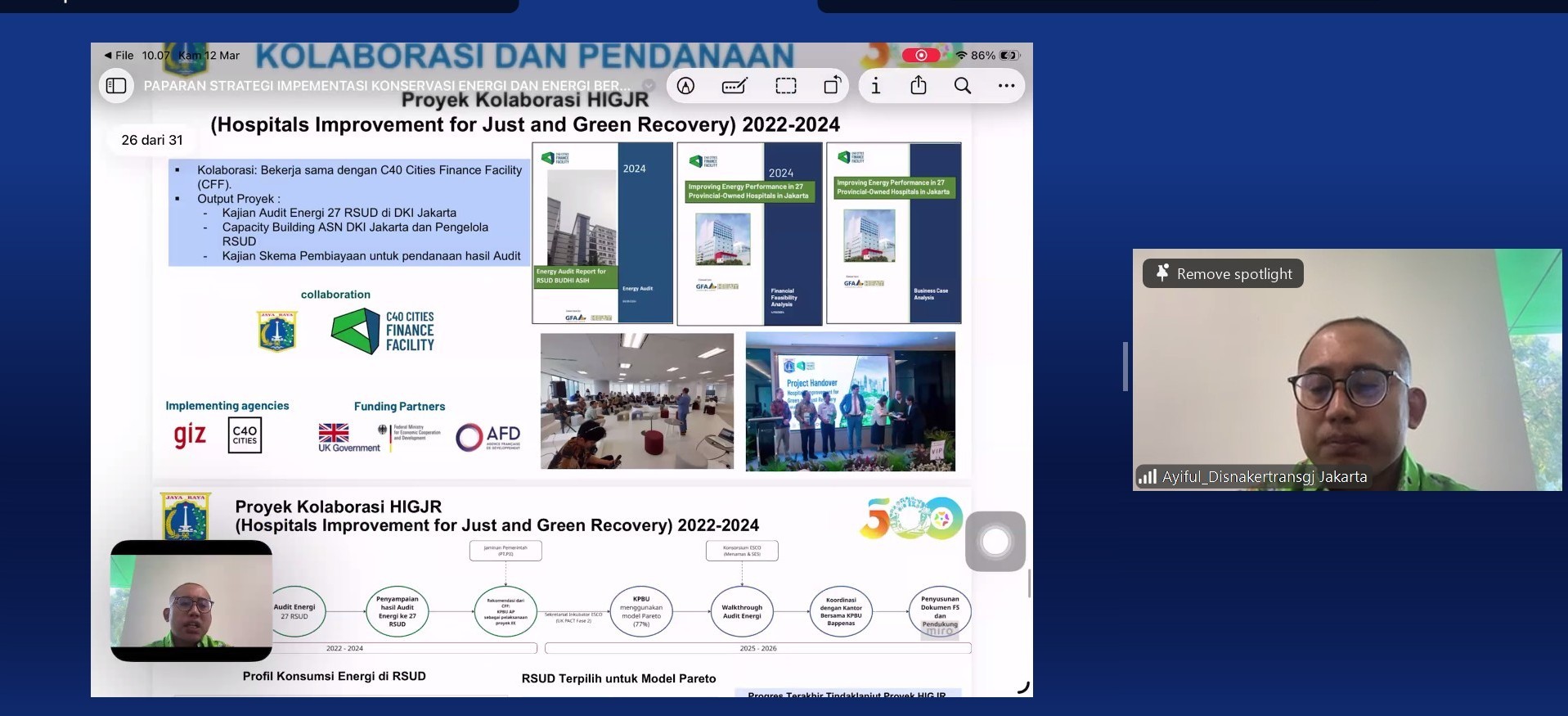
Ayiful Ramadhan Asit from the Jakarta Provincial Manpower, Transmigration and Energy Agency is seen sharing best practices on the Jakarta’s energy efficiency in the public building sector on 12 March 2026.
In the session, Ayiful Ramadhan, Head of Energy Sector of DKI Jakarta Provincial Manpower, Transmigration and Energy Office (Disnakertransgi DKI Jakarta) shared its best practice in leveraging rooftop solar through local fiscal capacity (APBD/Local Government Revenue and Expenditure Budget), along with strong collaboration with non-profits and the private sector. This has resulted in rooftop solar PV installations (PLTS Atap) across 196 government buildings, covering 143 schools, 18 offices, 24 healthcare facilities, and 11 sports facilities, with a total installed capacity of 4.765 MW as of 2025.
By 2024, the total solar energy capacity across government, private, and community sectors in Jakarta reached 34.38 MW.
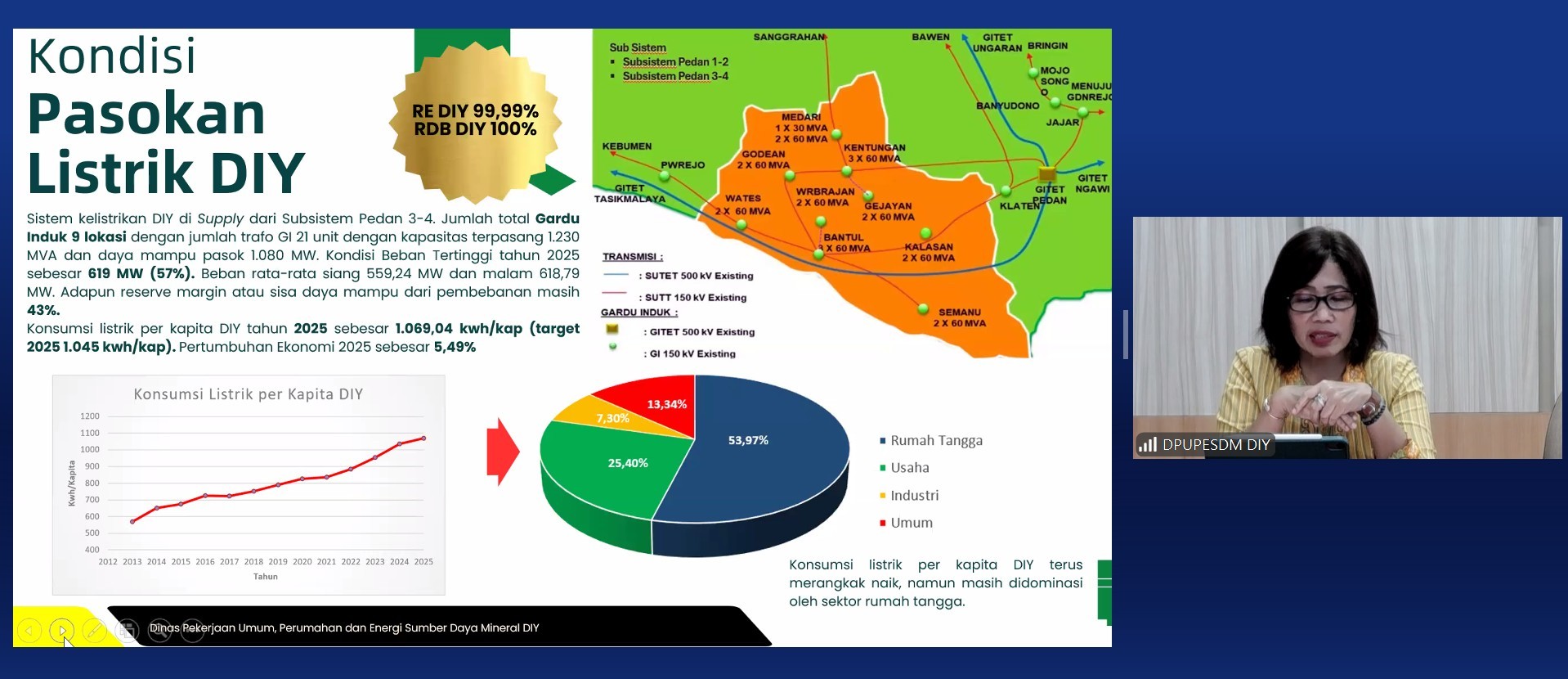
Anna Rina, Head of the Public Works, Energy and Mineral Resources Office (PUPESDM) of the Special Region of Yogyakarta (DIY), is seen presenting an overview of electricity supply in DIY during a peer learning session on 12 March 2026.
Anna Rina, Head of the Public Works, Energy and Mineral Resources Office (PUPESDM) of the Special Region of Yogyakarta (DIY) shared a key lesson learned. As an energy-importing region, DIY relies on external electricity supply, with households as the largest consumer, followed by the commercial sector, industry, and public services. As the region does not have fossil energy resources, it maximizes the use of its most promising RE sources—solar energy.
Through Governor Circular Letter No. 7/2026 on the utilization of rooftop solar (PLTS Atap) in DIY, all institutions, including public and private entities, state-owned and regionally owned enterprises (BUMN/BUMD), as well as universities, are encouraged to develop rooftop solar systems to improve energy efficiency and increase the share of renewable energy in the region.
This effort supports the region’s progress in advancing RE development. The installed capacity of rooftop solar PV has reached 6.19 MWp, with an estimated technical potential of 30 GW, supported by average solar radiation of 4.28–6.56 kWh/m²/day. With supportive policies in place, the regional energy mix has reached 9.45%, exceeding the 2025 target of 8.94%.
Dwi Suryono, Head of the Energy Office Branch in Central Java, emphasized that energy security and energy transition have been incorporated into the governor’s priority programs and the Regional Medium-Term Development Plan (RPJMD) 2026–2030.
The provincial government has integrated these commitments across many sectors, including through energy conservation programs and energy-saving initiatives for industry. In addition, rooftop solar systems have been installed in schools and Islamic boarding schools (pesantren).
Central Java has also fostered multi-stakeholder collaboration to expand RE development, involving NGOs, ministries, and universities. To date, rooftop solar installations in Central Java have reached 866 units, with a total capacity of 71 MW.
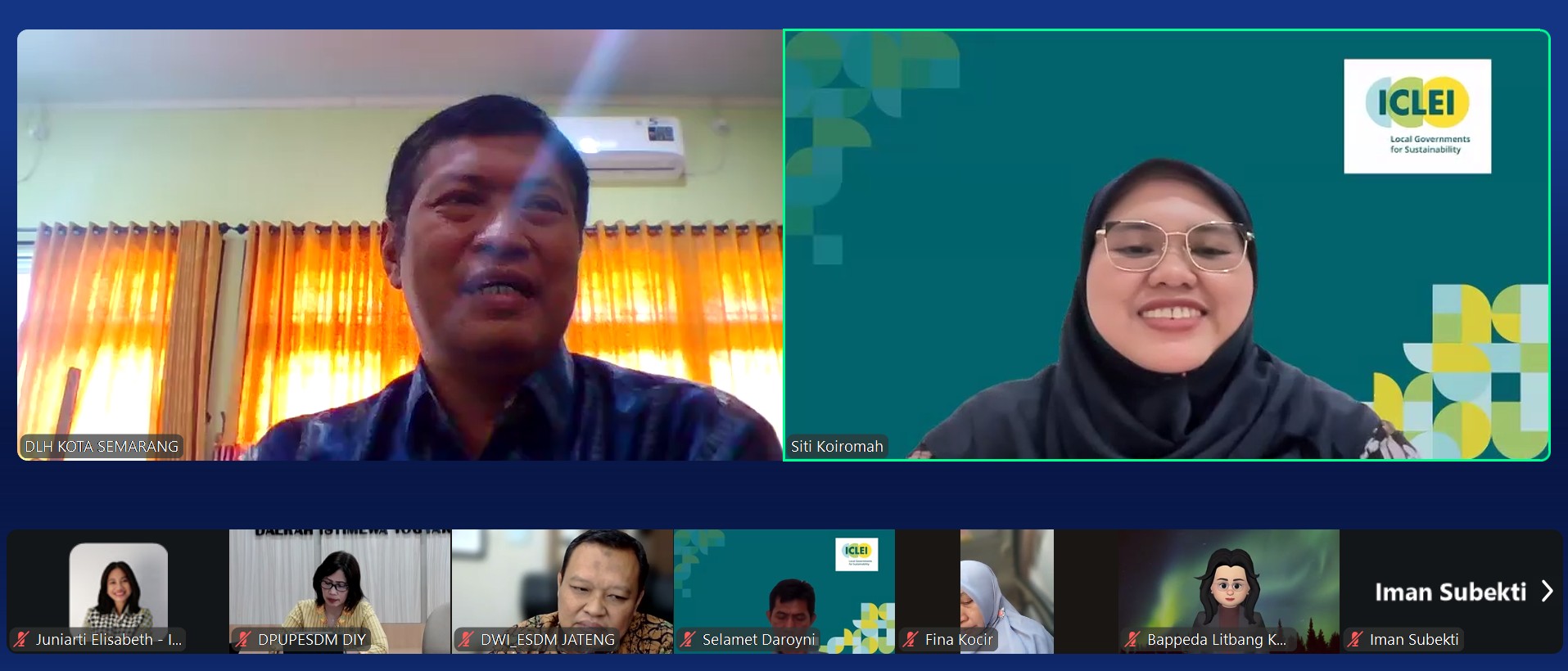
Local government participants in the energy sector from various cities were seen exchanging ideas during the Q&A session on 12 March 2026.
Further, the Q&A session highlighted several key challenges faced by local governments in energy management. These include limited staff capacity for energy audits, reliance on external experts, limited budgets for efficiency projects, and weak inter-agency coordination.
To address these gaps, the discussion emphasized the importance of prioritizing energy audits as a first step to identify savings potential. Energy efficiency in public buildings was highlighted as a key opportunity for cost reduction, while supportive local policies can help accelerate renewable energy adoption. In addition, alternative financing mechanisms such as ESCOs were seen as important to overcome budget constraints and speed up implementation. Stronger leadership was also noted as essential to improving cross-sector collaboration.
The RENEW-Southeast Asia project is currently in its second year of implementation, working to strengthen policy momentum, technical capacity, and advocacy opportunities for subnational governments in Indonesia and Malaysia. This implementation year will see RENEW-SEA placing a strong focus on the concept of positive energy buildings to empower local and regional governments in Indonesia and Malaysia to act with the resources at their disposal to drive the sustainable energy transition in their territories.
This article was co-written by Siti Koiromah, ICLEI Indonesia Project Officer.