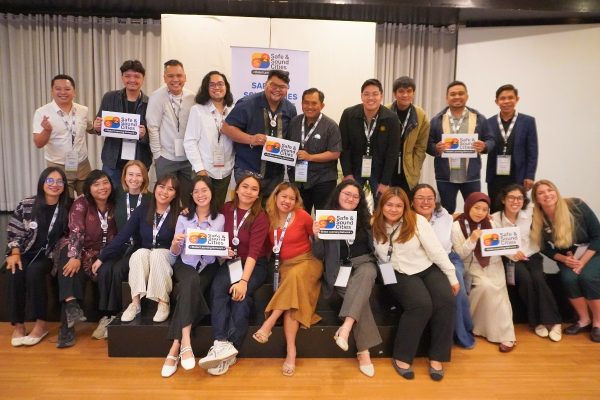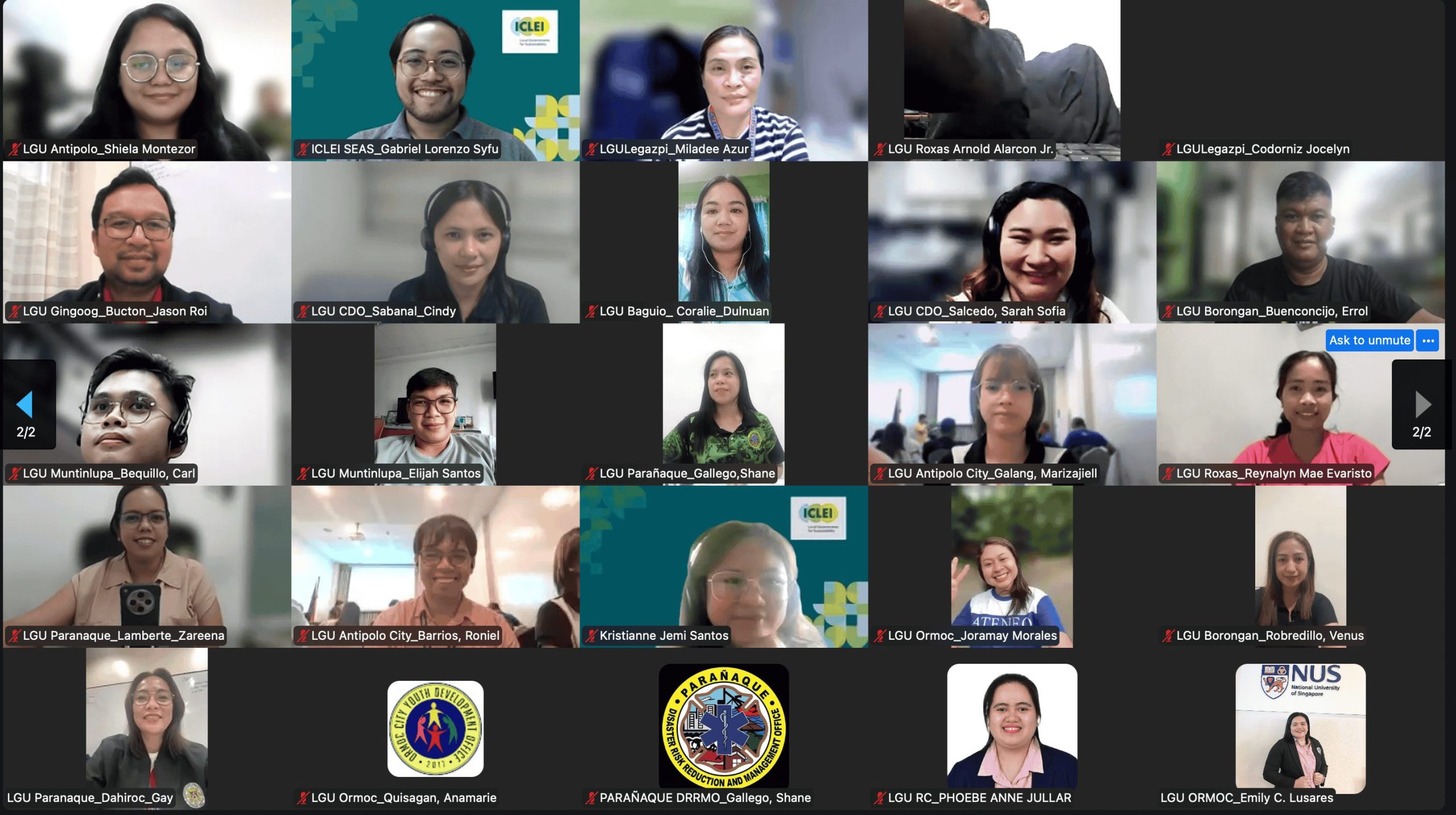
Fellows of the Socially Inclusive Resilience Leadership Program under the Enhancing Local Capacities in Socially Inclusive Resilience in Asia (SIRA) Project in the Philippines pose for a class photo with ICLEI SEA staff after a synchronous session on “Climate Change Adaptation and Disaster Risk Reduction” last September 4, 2025, via Zoom.
ICLEI Southeast Asia (SEA) concluded its capacity-building training sessions for the Enhancing Local Capacities in Socially Inclusive Resilience in Asia (SIRA) Project in the Philippines, having engaged representatives from various local government offices.
“Through the Leadership Program, the local government employees and staff—stretching various offices such as the City Environment and Natural Resources Office (CENRO), Disaster Risk Reduction and Management Office (CDRRMO), Environment and Waste Management Office (CEWMO), Social Welfare and Development Office (CSWDO), and Planning and Development Office (CPDO)—all honed their abilities and shifted their perspectives to not only see climate action as an environmental issue, but a deeply human issue, that requires appropriate people-centric and inclusive solutions,” said Gabriel Syfu, ICLEI SEA Project Assistant.
Funded by UK Aid through the Foreign Commonwealth and Development Office (FCDO) and the International Development Research Centre, Canada through the Climate Adaptation and Resilience (CLARE) programme and under the implementation of the ICLEI SEA and South Asia Secretariats, the SIRA project aims to identify and address the immediate capacity needs of local governments in pursuing climate action that is inclusive and sustainable through a systematic and phased capacity strengthening programme anchored on south-south cooperation among four Asian countries: Bangladesh, Indonesia, Nepal, and the Philippines.
The SIRA Project was officially launched in the Philippines in July 2024. Through its Socially Inclusive Resilience Leadership Program, the SIRA Project in the Philippines aims to build the technical capacity of local government staff from key offices involved in resilience planning and implementation, and build their expertise as leaders and key policy influencers that will shape socially inclusive climate solutions at the local level towards a more sustainable, inclusive, and resilient future.
The Socially Inclusive Resilience Leadership Program, structured as a 4-month-long fellowship program, engaged SIRA fellows from 15 participating LGUs who participated in weekly asynchronous classes and live sessions on topics that aim to develop their skills in effectively involve different stakeholders—including women, urban poor communities, children, persons with disability, LGBTQIA+ communities, indigenous communities, among others—to develop and implement local climate resilient actions that are inclusive and contribute to holistic and sustainable urban development.
The SIRA fellows represented the following local governments: Alaminos City, Antipolo City, Baguio City, Borongan City, Cagayan de Oro City, Del Carmen Municipality, Gingoog City, Iloilo City, Legazpi City, Muntinlupa City, Ormoc City, Parañaque City, Roxas City, and the Science City of Muñoz.
Training inclusive resilience leaders
ICLEI SEA developed training modules on the following core topics, which they delivered from September to December 2025: Socially Inclusive Resilience Building at the Local Level; Integrating Gender and Inclusion in Local Development Strategies; Building Resilience through Nature-based Solutions; and Financing Socially Inclusive Resilience at the Local Level.
The four core modules included subtopics, such as: Climate Change Adaptation and Disaster Risk Reduction and Management; Systems Thinking; Intersectionality and Climate Risks; Social Inclusion and Safety Nets for Vulnerable Sectors; Concepts of Gender, Persons with Disabilities, and other Vulnerable Groups; Tools and Entry Points for Gender Equality, Disability, and Social Inclusion (GEDSI) Mainstreaming and Integration into Local Programs, Projects, and Activities (PPAs); Knowledge Brokering; Investing in Nature-based Solutions; Accessing Climate Finance; and Developing Project Concepts for Climate Finance and Entry Points for Gender-Responsive Climate Finance.
“The SIRA fellows willingly shared their time to participate in the learning sessions, and this demonstrates their respective local governments’ commitment to improving the inclusivity of local resilience strategies and the dedication to their own professional growth as inclusive resilience leaders,” said Lendl Meniado, ICLEI SEA Project Officer.
ICLEI SEA also conducted live learning sessions for SIRA fellows, and invited experts on the covered topics to serve as resource speakers.
ICLEI SEA invited 11 experts from national government agencies, international organizations, and development institutions:
- Twyla Raros David, Country Program Manager for Gender and Child Rights at Plan International;
- Maria Isabel Lanada, PhD, Director IV at the Department of Social Welfare and Development’s (DSWD) Disaster Response Management Bureau;
- Maria Criselda “Krissy” Bisda, GEDSI expert;
- Dr. Maribeth Bugtong Biano, development professional and advocate for Indigenous Peoples’ rights;
- Karen Dagñalan-Dy, Supervising Gender and Development Specialist at the Philippine Commission on Women;
- Biplav Pradhan, Program Manager for Climate Adaptation and Resilience at PlanAdapt;
- Ma. Gerarda Asuncion D. Merilo, Supervising Environmental Management Specialist under the Climate Change Information and Technical Support Division (CCITSD) of the Department of Environment and Natural Resources (DENR) Climate Change Service;
- Oliver Agoncillo, Director of Mainstreaming Biodiversity Division at the ASEAN Centre for Biodiversity;
- Dean Maynard Roxas, Project Coordinator for the Sustainable Infrastructure Programme in Asia (SIPA) of the World Wide Fund for Nature (WWF);
- Grace Louie Mantos-Boongaling, Director of the Administrative, Financial and Management Service at the Department of Finance’s Bureau of Local Government Finance (BLGF); and
- Marino Deocariza, Urban Development and Climate Resilience Specialist at the Asian Development Bank’s (ADB) Urban Resilience Trust Fund Secretariat.
After the training modules, SIRA fellows will develop a capstone project concept on socially inclusive resilience and conduct a Town Hall COP (Conference of the Parties) in their city as part of the Socially Inclusive Resilience Leadership Program.
CLARE is a UK-Canada framework research programme on Climate Adaptation and Resilience, aiming to enable socially inclusive and sustainable action to build resilience to climate change and natural hazards. CLARE is an initiative jointly designed, funded and run by the UK Foreign Commonwealth and Development Office and Canada’s International Development Research Centre. CLARE is primarily funded by UK aid from the UK government, along with the International Development Research Centre, Canada.