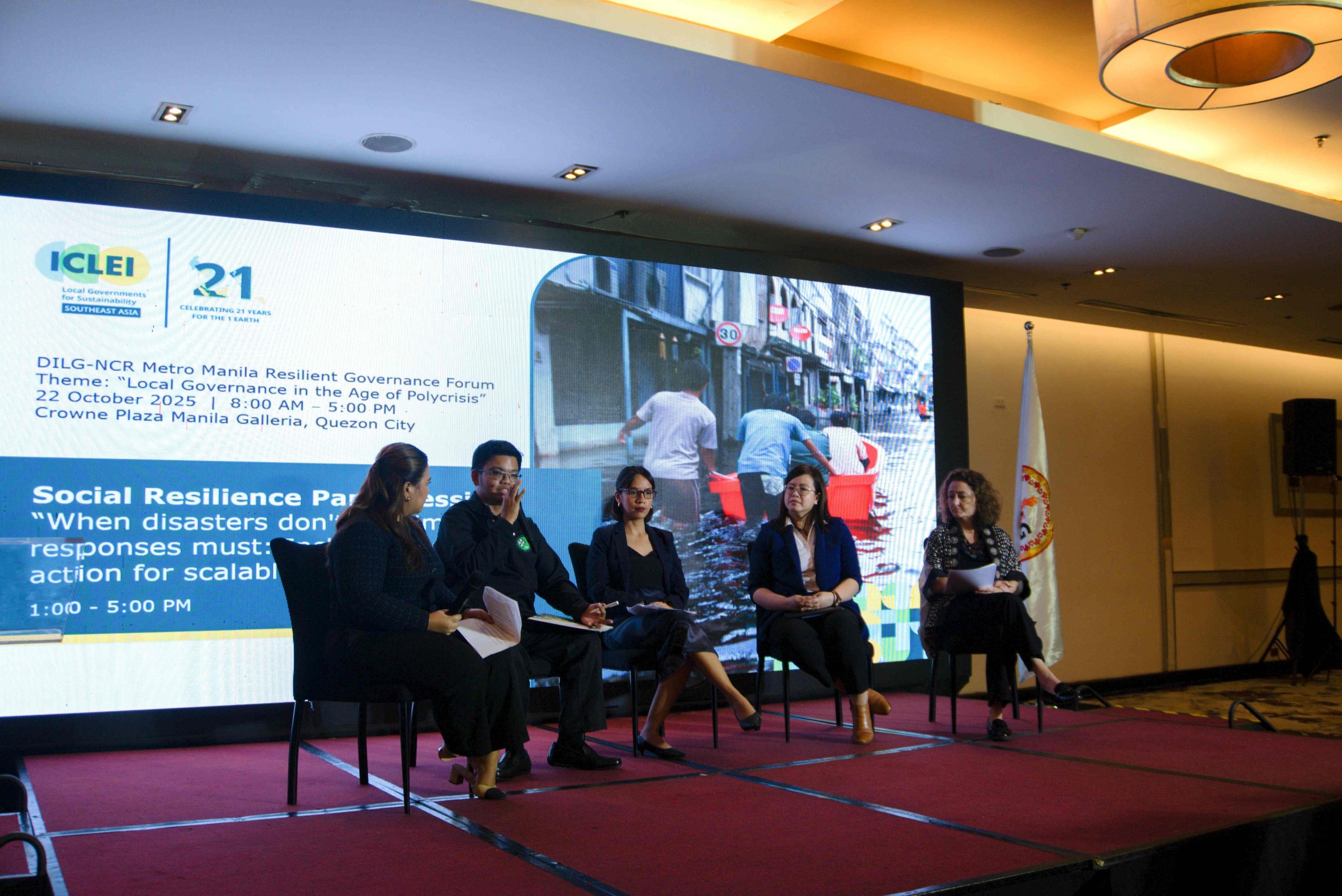
ICLEI SEA invited experts to serve as panelists in a discussion on social resilience, titled “When disasters don’t discriminate, responses must: Inclusive local action for scalable national resilience,” hosted by ICLEI SEA during the 2025 MMRGF. Kristianne Jemi Santos (leftmost), ICLEI SEA Senior Project Officer, moderated the discussion with the following panelists: (L-R) Marion Tinio, Senior Transport Researcher of Clean Air Asia; Lendl Meniado, ICLEI SEA Project Officer; Rea Geraldino, Senior Program Manager of the National Resilience Council (NRC); and Tristan Burnett, Chief of Mission in the Philippines of the International Organization for Migration (IOM).
A flooded street can mean more than just an impassable road. For marginalized communities, this entails missed school days, lost income, and health risks—socioeconomic vulnerabilities that are intensified by climate change, and, when overlooked in resilience building, will continue to hinder people from improving their quality of life.
At the 2025 Metro Manila Resilient Governance Forum (MMRGF), ICLEI Southeast Asia (SEA) convened a panel discussion on social resilience that examined how local governments can strengthen social safety nets as a core element of resilience building. Titled “When disasters don’t discriminate, responses must: Inclusive local action for scalable national resilience,” the session brought together experts to explore what social resilience means in practice and how local governments can advance inclusive approaches to resilience.
After the discussion, ICLEI SEA engaged participants in an empathy mapping activity as an exercise in inclusive resilience planning.
Organized by the Philippine Department of the Interior and Local Government – National Capital Region (DILG-NCR) last October 22, 2025 at Crowne Plaza Manila Galleria, Quezon City, the MMRGF gathered local governments in the NCR to explore actionable solutions that can collectively address the region’s interconnected urban challenges, under the theme, “Local Governance in the Age of Polycrisis.”
Below are some of the key highlights of the panel discussion and the empathy mapping activity.
1) Make migration a choice, not a need
Tristan Burnett, Chief of Mission in the Philippines of the International Organization for Migration (IOM) and a panelist of the social resilience session, highlighted how urban migration often results from necessity rather than choice, leading to various risks for migrants.
To address this, Burnett said it is important to implement inclusive safety nets that empower individuals so that migration is a choice rather than a necessity. Key strategies include integrating migration into climate planning, investing in climate-resilient infrastructure, and supporting vulnerable communities with access to livelihoods.
Moreover, she emphasized that planning for relocations should be comprehensive and proactive, and that social resilience should be considered alongside physical infrastructure.
2) Resilience must be measured
Rea Geraldino, Senior Program Manager of the National Resilience Council (NRC), talked about the NRC’s Local Government Systems Scorecard.
The scorecard is a guide or tool designed to assess resilient local governance through a whole-of-society, science-driven approach by evaluating local government preparedness and monitoring the resilience of the local government unit’s (LGU) system. It emphasizes proactive strategies for preparedness, adaptation, and mitigation, highlighting the crucial role of local leaders and multi-perspective assessments in mainstreaming resilience.
The scorecard includes five resilience pillars: (1) Human Development, (2) Local Economy, (3) Environment, (4) Infrastructure, and (5) Human Security. Social protection is a sub-pillar under Human Development, along with health systems and sustainable education.
The scorecard, Geraldino noted, is not just a self-assessment tool because it is also validated by stakeholders, including those from the academe and private sector.
Geraldino said that 30 local government units have used this scorecard since 2017, which aims to complement LGUs’ efforts instead of duplicating them.
3) Safe, inclusive cities are resilient cities
Marion Tinio, Clean Air Asia’s Senior Transport Researcher, shared three ways to design cities that are safe and inclusive to increase social resilience: (1) Recognize different needs, (2) Strengthen various abilities, and (3) Preparing for different responses. He shared local examples of how these methods were applied in the Philippines.
He also emphasized the need for local governments to have disaggregated data and data management systems, and that hazard data needs can vary and transcend geographic boundaries.
4) Intersecting crises require multi-level collaboration
Climate change adaptation at the local level requires multi-level collaboration, as emphasized by Lendl Meniado, ICLEI SEA Project Officer.
Meniado talked about the Enhancing Local Capacities in Socially Inclusive Resilience in Asia (SIRA) Project, currently implemented by ICLEI SEA in the Philippines, which aims to develop local governments’ capabilities in pursuing four (4) opportunities for them to lead resilience-building efforts. These opportunities include: (1) Institutionalizing risk-informed planning and participatory decision-making to ensure solutions are both science-based and socially just; (2) Making resilience plans inclusive by actively engaging with communities and understanding their realities; (3) Investing in nature-based solutions for cost-effective and long-term strategies; and (4) Fostering partnerships and learning exchanges within and outside local governments, including collaboration with national agencies and development organizations.
Furthermore, Meniado stressed the importance of institutionalizing local resilience efforts.
Strengthening partnerships among Metro Manila cities
“We believe that resilient governance means not just preparing for shocks, but also building prosperity that lasts. And in Metro Manila, one of the most complex urban regions in the world, this means fostering stronger coordination among local government units and national government agencies, empowering barangays (villages), and ensuring that communities themselves become co-creators of solutions,” said Mae Valdez-Irong, ICLEI SEA Regional Program Manager, in her message during the opening of the 2025 MMRGF.
Metro Manila is one of the most urbanized and highly dense regions in Southeast Asia that faces overlapping and interconnected risks such as flooding, typhoons and heat, as well as geological risks in areas surrounding the West Valley Fault.
The region also produces 32% of the country’s GDP, which puts it in a unique and transformative position to champion inclusive and resilient development, paving the way for other cities. This is why ICLEI Southeast Asia and DILG NCR continue to collaborate in harnessing the capacities of NCR cities towards resilience.
“Resilience is not just about bouncing back; it is building back better. It is about transforming the very systems that make us vulnerable and building communities that are safe, adaptive, and sustainable,” said Valdez-Irong.
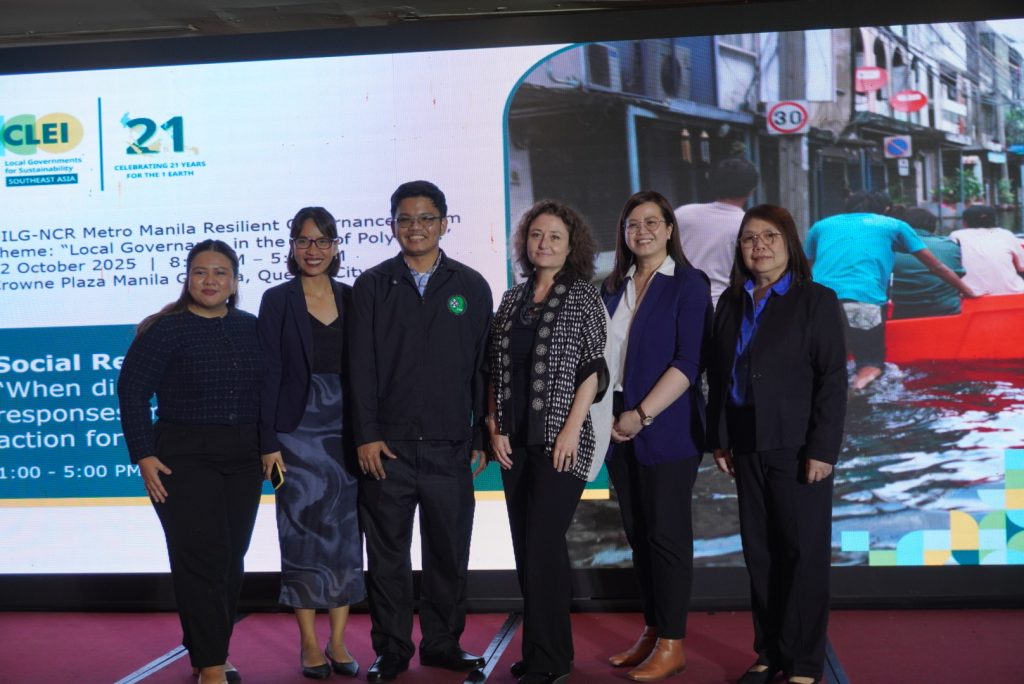
(L-R) Kristianne Jemi Santos, ICLEI SEA Senior Project Officer; Lendl Meniado, ICLEI SEA Project Officer; Marion Tinio, Senior Transport Researcher of Clean Air Asia; Tristan Burnett, Chief of Mission in the Philippines of the IOM; Rea Geraldino, NRC Senior Program Manager; and DILG-NCR Regional Director Maria Lourdes L. Agustin, CESO III.
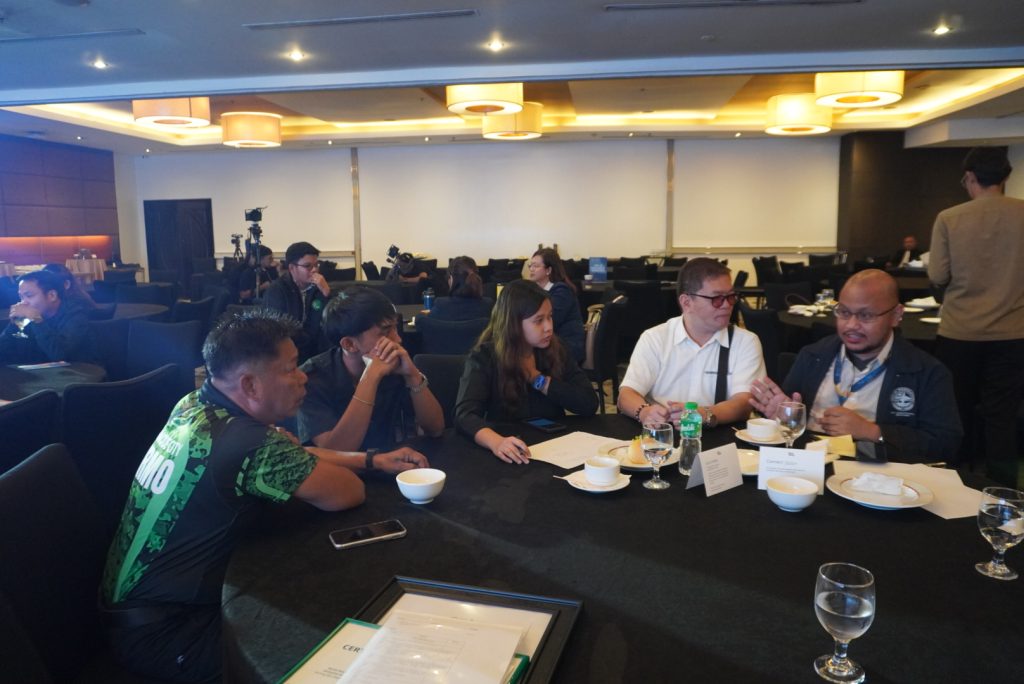
Participants of the social resilience panel discussion engage in an empathy mapping activity, also facilitated by ICLEI SEA.