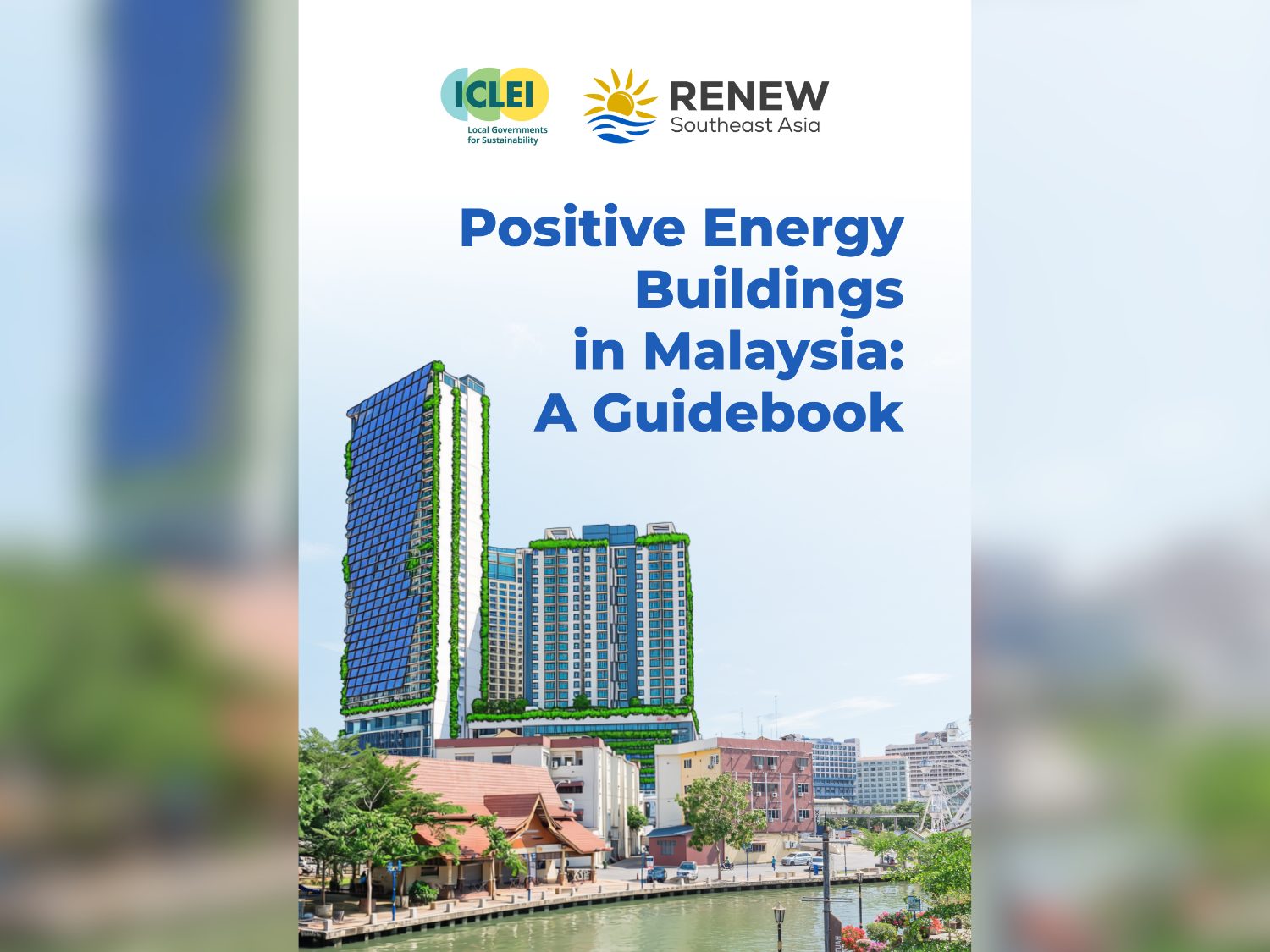
Read the full knowledge product HERE.
Executive Summary
Malaysia is one of the most urbanized countries in Southeast Asia, and its building sector reflects that. Buildings account for approximately 48% of national electricity consumption, driven overwhelmingly by cooling: air conditioning alone is estimated to account for 53% of electricity used across the commercial and residential stock. Population growth is projected to continue through to 2059, generating sustained demand for larger homes, more commercial office floorspace, and expanded public facilities. The gap between what Malaysian buildings currently consume and what they should consume is already visible in the numbers: office buildings routinely operate at 220 to 300 kWh per square meter per year against a national benchmark of 200, and most of the public estate has no systematic energy monitoring. Positive Energy Buildings (PEBs), buildings that generate more energy than they consume over a year through the combination of passive design, energy efficiency, and on-site renewable generation, represent the ambition level that Malaysia’s building frameworks can and should progressively move toward.
This guidebook is addressed to local and regional governments (LRGs) in Malaysia. Across 156 local authorities, LRGs sit at the junction of planning, asset ownership, and community delivery in a way that no other tier of government does. The Town and Country Planning Act gives them primary authority over development approvals and local plans. KPKT has called on all 156 local authorities to urgently implement energy planning and conservation measures across public facilities. LRGs that act on their own public buildings, hospitals, offices, schools, civic facilities, do more than reduce energy costs on those assets. They generate the performance evidence that financing partners and ESCOs need to price deals, they demonstrate the institutional competence that makes broader enforcement credible, and they begin to build a local market for the services and financing products that the private sector will eventually need too. A companion guidebook addresses the same set of questions for Indonesian LRGs.
Malaysia has built one of the most developed policy architectures for building energy performance in the region. The Energy Efficiency and Conservation Act 2024 creates the first comprehensive mandatory framework for large buildings. The National Energy Transition Roadmap sets a 40% renewable energy target by 2035 and commits to an ESCO platform and revolving fund for public building retrofits.[iv] Green building rating systems have been operating since 2009. The instruments that should translate this framework into LRG action also exist: the Green Technology Financing Scheme, NEM GoMEn’s 100 MW government solar track, the SARE tripartite contracting model already deployed at city councils in Johor Baru, Seremban, and Ipoh, and GITA/GITE incentives that improve the economics for contracted delivery parties. The challenge is that most of these instruments are not directly accessible to LRGs as they stand. GTFS requires a minimum 60% Malaysian shareholding that most public entities cannot satisfy, ESCO EPC faces procurement-rule barriers that EECA and the NETR are intended to resolve, and building-level energy data remains too fragmented to structure bankable investment cases. The gap sits not within the policy architecture but in the preparation required to use it.
The central finding of this guidebook is that PEBs are feasible in Malaysia in three respects.
- Technically, because the solar resource is strong and the demonstrated performance of buildings like the Energy Commission Diamond Building in Putrajaya and the MGTC Green Energy Office in Bangi show what is achievable in the Malaysian tropical context
- Financially, because the instrument landscape, when properly navigated, can finance the journey, and
- Institutionally, because Melaka’s decade of sustained policy commitment shows what a local government that takes this seriously can build.
What is missing for most LRGs is not any one of these elements in isolation, but the sequencing that connects them. This means the energy baseline that makes an investment case possible, the governance structure that makes a procurement credible, and the first completed transaction that makes the next one easier. This guidebook examines the pathway to build each in turn.
Read the full knowledge product HERE.