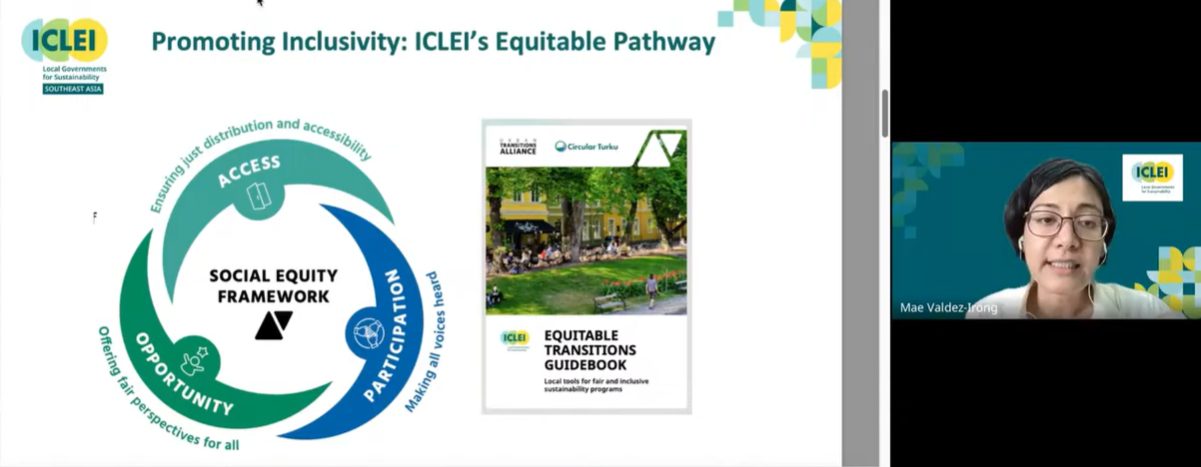
Mae Valdez-Irong, ICLEI Southeast Asia (SEA) Regional Program Manager, talks about ICLEI’s Equitable Transitions Guidebook as one of the resource speakers in the ASEAN Disability Forum’s (ADF) 3rd virtual public discussion on disability, gender, and climate change last June 18, 2025. (Screenshot from the ASEAN Disability Forum’s YouTube video, “Public Discussion on Disability, Gender, and Climate Change Series 3”)
ICLEI Southeast Asia shared its experience in developing inclusive local climate action plans and policies through its Regional Program Manager, Mae Valdez-Irong, who served as one of the resource speakers in the ASEAN Disability Forum’s (ADF) 3rd virtual public discussion on disability, gender, and climate change.
The third discussion, held last June 18, 2025, focused on the topic, “Develop ASEAN Action Plan on Climate Change to the COP30 (30th United Nations Climate Change Conference)” with the aim to raise awareness on and support disability inclusion in climate action plans in the ASEAN and COP.
Valdez-Irong talked about inclusivity challenges at the local level, which include challenges in the planning process, designing interventions, and climate action strategies.
Among the challenges she mentioned are the lack of disaggregated data on vulnerable groups such as persons with disabilities (PWDs), and their lack of participation in policymaking and governance processes; a “one size fits all” approach in designing climate interventions that are not inclusive and accessible enough; inaccessible formats for climate information; infrastructure and mobility barriers; and lack of sustainable livelihood opportunities.
Equitable transitions guidebook
To help local governments address challenges in inclusive climate action planning, Valdez-Irong shared ICLEI’s Equitable Transitions Guidebook, which details ICLEI’s methodology to map social equity outcomes of local sustainability plans across three dimensions: access, participation, and opportunity.
The guidebook also provides tools and recommendations for action for each dimension, as well as indicators to monitor progress and best practices from cities of the ICLEI network to learn from.
“For example, in terms of access, [ICLEI encourages local governments] to apply place-based approaches to support vulnerable neighborhoods; ensure equal access irrespective of gender, age, abilities, and origin; and innovative funding models to empower low-income communities. For participation, we encourage them to identify vulnerable groups to ensure diversity in program design and [co-creation]. We give emphasis to co-creation because we believe that climate action interventions should be designed with—not for—persons with disabilities,” said Valdez-Irong.
Co-creation also includes building on existing initiatives to empower local actors.
“For opportunity, we encourage them to prioritize vulnerable groups in municipal employment programs…boosting employability through trainings and upskilling, and supporting the market conditions for long-term equitability,” she added.
Moreover, Valdez-Irong briefly shared the inclusive approach of the Sparking Active Mobility Actions for Climate-Friendly Cities (SPARK) Project where walkability and cyclability assessments included the perspective and experiences of PWDs.
Town Hall COP
Valdez-Irong also mentioned ICLEI’s Town Hall COP approach, which aims to provide an inclusive space for communities to make sure their voices and priorities are included in national climate plans and implementation and global climate discussions.
Inspired by the structure of international UN Climate Change Conferences (COPs), Town Hall COPs are local, community-led climate dialogues designed to review local climate progress; align with national climate goals; and identify actions that address real community priorities like health, justice, jobs, and nature.
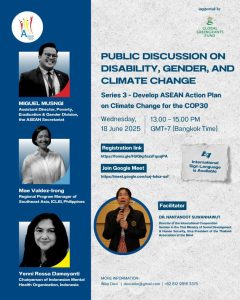
Digital poster for the ASEAN Disability Forum’s (ADF) 3rd virtual public discussion on disability, gender, and climate change.