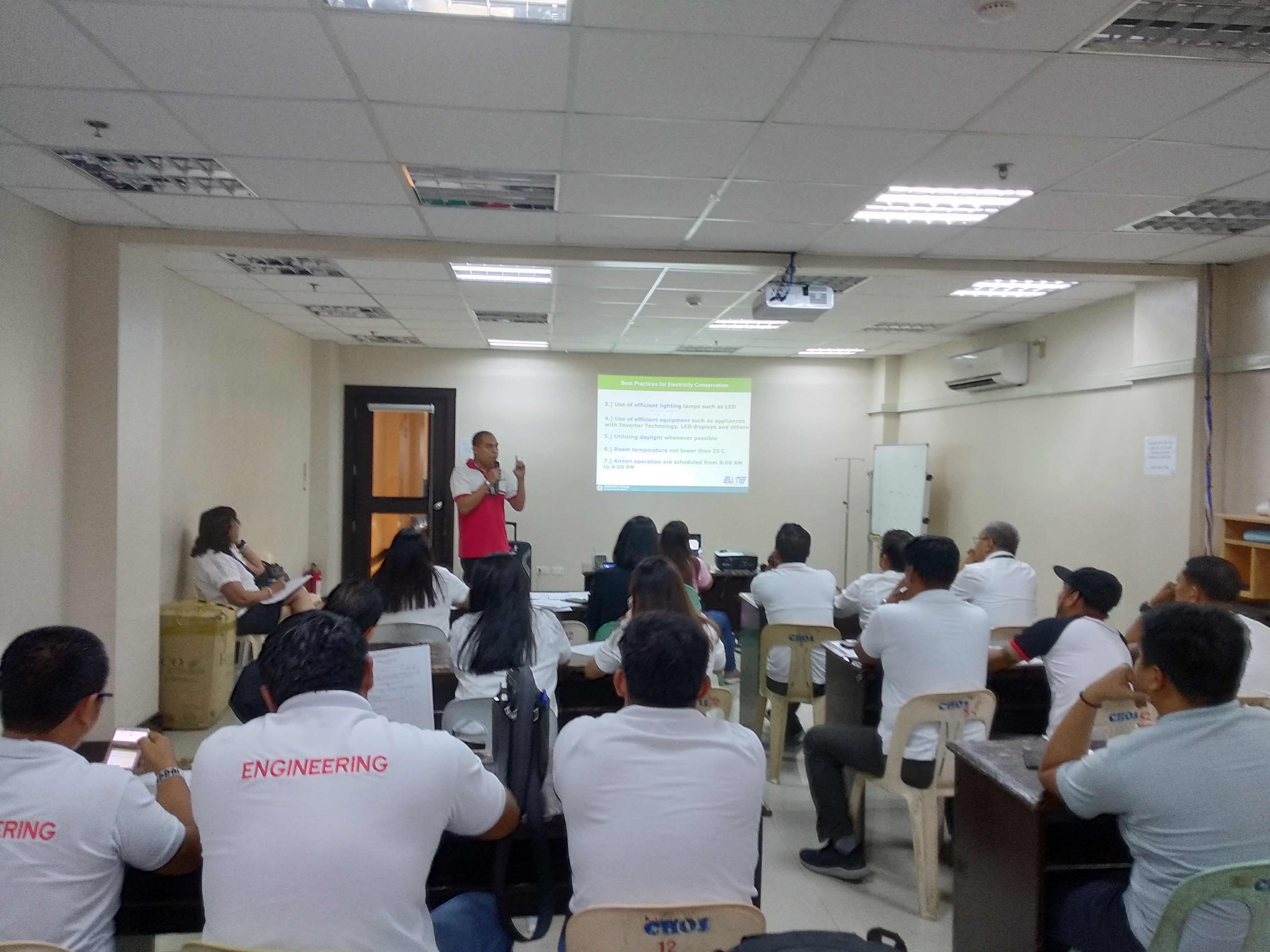
Santa Rosa, Philippines: ICLEI – Local Governments for Sustainability Southeast Asia Secretariat (ICLEI SEAS), in coordination with the Department of Energy (DoE), conducted a building energy efficiency and conservation workshop for the City Government of Santa Rosa, Laguna on 29 April 2019. This activity, attended by at least 20 technical staff and representatives from the City Environment and Natural Resources Office (CENRO) and City Engineering Office, is part of the Building Efficiency Accelerator (BEA) Project.
Ms. Anna Dominique Ortiz, ICLEI SEAS Project Officer for Energy and Built Environment, opened the workshop by introducing BEA and its role in connecting local action to global agenda such as the Sustainable Energy for All and Paris Climate Agreement. BEA is a private-public collaboration helping local governments to implement building energy efficiency practices and policies
Engr. Tony Nabong, the Energy Audit Team Leader of DOE’s Energy Utilization Management Bureau (EUMB) – Energy Efficiency and Conservation Division (EECD), highlighted that the local governments will take part in formulating the Implementing Rules and Regulations of the anticipated enactment of the Energy Efficiency and Conservation Act. Should the Energy Efficiency and Conservation Act be enforced, local governments would be mandated to create an Energy Efficiency and Conservation Office.
Implementing building energy audit
Focusing on lighting and air conditioning, Engr. Aaron Premacio of EUMB-EECD also demonstrated how to conduct a building energy unit. A lux meter to measure brightness in an area and a thermostat was used. Overall, the building energy audit involving three City Government offices resulted in a passing score of 73.7% which entailed room for improvement in implementing energy efficiency and conservation measures.
According to Engr. Premacio, “the local government must keep an inventory of its equipment and document monthly electricity consumption. The inventory must also include service vehicles and their fuel consumption as a form of energy used.”
Employing energy-saving opportunities
Apart from the retrofitting of lamps to LED, EUMB-EECD outlined energy efficiency and conservation practices that a local government may apply, such as:
- Installing external shading on buildings to prevent unwanted heat from the sun;
- Encouraging use of stairs instead of the elevator whenever possible;
- Shifting to an inverter AC as its compressor operates on variable speed as compared to a non-inverter AC that runs on a single speed. To illustrate, when setting the AC at 25°C, the compressor in an inverter AC slows down when it reaches the desired temperature, whereas a non-inverter type switches off. When the room eventually warms, the non-inverter AC re-activates at maximum speed. The constant shift in speed in non-inverter AC forces the compressor to work more, thus consuming more energy.
However, EUMB-EECD raised to weigh benefits and costs before shifting to energy-efficient technologies because its upfront cost is more expensive compared to conventional technologies.
In response to the workshop, the City Government of Santa Rosa intends to formalize energy conservation measures through issuances or a memorandum. City Environment Officer Erlinda Creencia also requested the City Engineering Office to employ alternate lighting in her office to save electricity.
With assistance from the BEA, the City Environment Office is targeting to engage the Philippine Green Building Council in drafting their local Green Building Code. This will enable mainstreaming of building energy efficiency measures not only in the City Hall but also among the commercial and manufacturing sectors of the City of Santa Rosa.
Download the full activity report here.