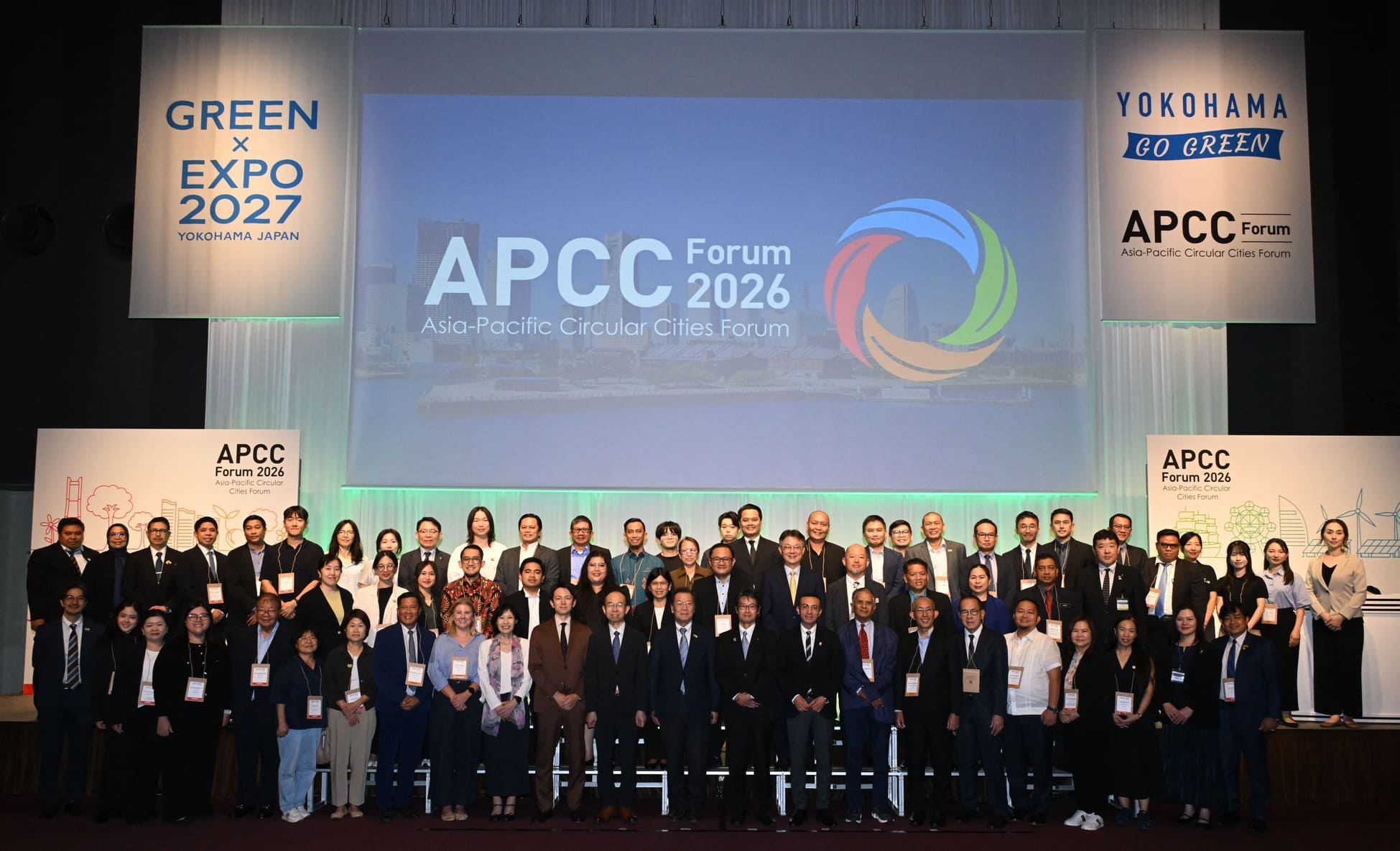
Seventeen local governments joined the Asian Circular Cities Declaration (ACCD) in September, expanding the regional network from 26 cities in seven countries to 43 cities in 11 countries representing more than 82 million people. The new signatories were announced during the inaugural Asia-Pacific Circular Cities Forum, hosted by the City of Yokohama and co-hosted by ICLEI Japan from 2 to 4 September 2026.
Five of the 17 new signatories are from Southeast Asia: Cebu Province and Danao City in the Philippines; George Town in Malaysia; and Jayapura City and Probolinggo City in Indonesia.
The five new Southeast Asian signatories join 16 founding ACCD signatories from the region: Baguio City, Borongan City, Cebu City, Del Carmen Municipality, Makati City, Mandaue City, Muntinlupa City, and Quezon City in the Philippines; Balikpapan City, Bogor City, Jakarta Special Capital Region, Makassar City, and the Nusantara Capital Authority in Indonesia; Bangkok Metropolitan Administration in Thailand; Da Nang City in Viet Nam; and Seberang Perai City in Malaysia.
Among these Southeast Asian ACCD signatories, Baguio City, Balikpapan City, Bogor City, Borongan City, Del Carmen Municipality, Jakarta Special Capital Region, Makati City, Muntinlupa City, Probolinggo City, Quezon City, and Seberang Perai are ICLEI members in the region.
The forum also introduced ACCD Action 2026, the declaration’s first action plan. It establishes working groups focused on documenting and sharing city practices, supporting cities in adopting private-sector solutions, and developing methods to track progress under the ACCD. The plan also calls for closer engagement with national governments and international organizations and for expansion of the ACCD network and its secretariat functions.
The action plan responds in part to a survey of ACCD cities conducted by ICLEI Japan. The survey found market creation to be a common challenge. Local regulations, public procurement and incentive schemes were the weakest policy areas among responding cities, while frameworks for repair, reuse and secondary-material markets emerged as the largest shared gap. Meanwhile, responding cities reported that circular-economy goals, strategies and awareness activities were already in place.
Proposed by the City of Yokohama, the ACCD was announced by ICLEI Japan in November 2025 as a framework for advancing circular cities across Asia. The Declaration provides a non-binding regional framework through which Asian cities can pursue circular-economy approaches and exchange experience.